


09 mart. Deconstructing My Photos – How Analyzing Your Images Helps You Become a Better Photographer
When I switched from Sony to Fuji cameras, I had no idea how much photography would grow on me.
Of course, I wanted to improve and take better photos, but after my first major photography trips I realized something important: simply taking more pictures does not automatically make you a better photographer.
I was shooting frequently — landscapes, cities, mountains, travel scenes — but when I reviewed my work I noticed that only a small number of photos were truly strong enough to share or print.
That raised an important question.
How can you improve as a photographer and increase the number of photographs you are proud of?
Over time I discovered a simple but powerful approach: learning to deconstruct my own photos.
Why Reviewing Your Own Photos Is Important
Many photographers take thousands of photos but rarely stop analyzing them carefully.
Looking critically at your images is one of the best ways to improve your photography skills.
Instead of simply asking “Do I like this photo?”, it is much more useful to ask deeper questions such as:
• What is the subject of this image?
• Does the composition guide the viewer’s eye correctly?
• Is the image simple and easy to understand?
When you begin to analyze your photos in this way, you start noticing both strengths and mistakes much more clearly.
This process helps you make better decisions the next time you go out shooting.
Three Principles I Use When Analyzing My Photos
While reviewing my work and receiving feedback from professional photographers, I realized that most strong images share three important characteristics.
1. A clear subject
Every photograph should have a clear subject.
The viewer should immediately understand what the photo is about without needing additional explanation.
If the viewer must search for the subject, the image usually becomes confusing.
2. The photo must draw attention to the subject
Once the subject is identified, the composition must guide the viewer’s eye toward it.
This can be achieved using techniques such as:
• leading lines
• light and contrast
• framing
• rule of thirds
If the viewer’s attention is scattered across the image, the photograph loses impact.
3. Simplicity in composition
One of the biggest mistakes photographers make is including too many elements in the frame.
A strong photograph is usually simple.
Unnecessary objects, distracting backgrounds or cluttered scenes make it harder for the viewer to understand the story.
Removing distractions often improves a photograph dramatically.
Example 1 – Capturing Emotion in a Simple Scene

One of the photos I analyzed was taken during a sunset on a beach in Lefkada.
While photographing kitesurfers I noticed a child playing in the water.
The scene represented something simple but powerful: freedom, joy and the feeling of a summer evening by the sea.
In the photo I tried to:
• place the sun using the rule of thirds
• create depth using multiple layers
• include a human element to tell a story
The backlight from the setting sun prevented the viewer from clearly seeing the child’s face, making the figure more universal.
It could be anyone.
However, after receiving feedback from a professional reviewer, I realized that the human element might not have been positioned strongly enough to become the main subject.
This showed me that even when the idea behind a photo is strong, composition still matters greatly.
Example 2 – Using Scale and Atmosphere
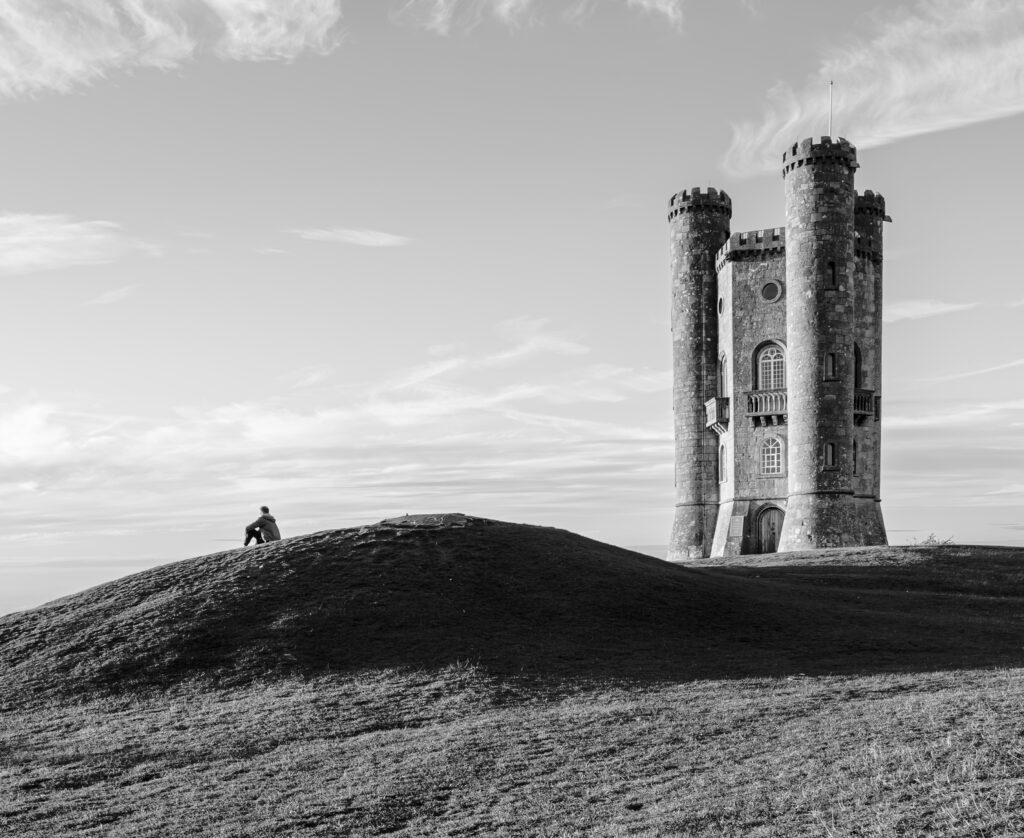
* fun fact- I converted the picture in black and white, used another crop and became my most awarded photo in international competitions
Another image I analyzed was taken in England during a trip near Broadway Tower.
The photo included a person standing on a hill while the tower appeared in the background.
In this case, the human figure worked well because it provided scale and helped the viewer understand the size of the landscape.
The reviewer mentioned several positive aspects:
• good use of light
• strong composition
• the figure added interest and scale
However, the editing was slightly too strong.
This highlighted another important lesson: even when the composition works well, processing can influence the final impact of the image.
Example 3 – When a Photo Lacks a Clear Subject

* small disclaimer here- I couldn’t find the Fujifilm picture I took so this one was the exact one but taken with my phone.
The third image I analyzed was taken in Romania and showed a wide mountain landscape.
While the view was beautiful, something felt wrong about the image.
After receiving professional feedback, the problem became clear.
The photo lacked a strong subject.
Although the sky, mountains and trees were visually interesting, the foreground contained distracting elements and the composition did not guide the viewer toward a clear focal point.
This revealed an important lesson in landscape photography.
A great background alone is not enough.
The foreground, midground and background must all work together to create a balanced and compelling image.
Learning from Criticism
Having your photos reviewed by professional photographers can sometimes be uncomfortable.
Criticism can feel discouraging at first.
However, honest feedback is one of the fastest ways to improve your photography.
A professional reviewer can identify issues that you might not notice yourself, such as:
• weak composition
• distracting elements
• editing problems
• lack of a clear subject
By understanding these mistakes, you can avoid repeating them in future shots.
Why Deconstructing Photos Improves Your Photography
Analyzing your own photos forces you to slow down and think more carefully about how images are created.
Over time, this process changes how you shoot.
Instead of simply reacting to a beautiful scene, you begin asking important questions before pressing the shutter:
• What is the subject of this photo?
• How can I simplify the composition?
• Does every part of the frame contribute to the image?
This type of thinking gradually leads to stronger photographs.

Final Thoughts
Improving as a photographer is not only about buying better gear or traveling to spectacular locations.
Sometimes the most valuable improvement comes from simply studying your own work.
Look at your photos carefully.
Analyze what works and what doesn’t.
Pay attention to subject, composition and simplicity.
And most importantly, don’t be afraid of criticism.
Every honest review is an opportunity to become a better photographer.
Fără comentarii